Cinematic wide shot, low angle on a young nun in flowing black habit and round sunglasses perched atop a galloping ostrich across a flat ochre desert, gold revolver raised and pointed skyward as she rears back with a wild laugh. Wind whips her veil and the bird's feathers in unison, sand churned into a long contrail behind. Tarantino-esque saturated tones, anamorphic flares, deliberate absurd grandeur.

Full Model Evaluation

Seedance 2.0

By MegatonJuly 11, 2026
Share

ByteDance's Seedance 2.0 is a unified text-to-video and image-to-video model released in early 2026, built around precise motion rendering, consistent characters, and synchronized audio. It's debut marked controversy and backlash in Hollywood and marked an inflection point for AI video.

We tested it against 122 prompts and 350 tests across realism, animation, and human performance, and the results genuinely impressed us. It tops our rankings by a significant margin over its peers while securing first or second place in every subcategory we measure against. From a nun galloping on an ostrich to a detailed tilt-shift animation of a miniature boulder, to precise knife cuts in an anime cooking scene, it achieved a high fidelity unmatched by any other model currently released. ---

Prompt
Stylized fashion campaign motion piece, locked symmetrical wide on a young man in pastel sportswear lounging on a single chair at center-court, one sneaker propped on a cooler box of citrus, phone held to his ear. He nods slowly to whatever he's hearing, the corner of his mouth lifting. Pastel-pink and turquoise color blocking, bougainvillea bursting at the edges, midday sun flattening shadows, Wes Anderson symmetry, no movement except his breath and a single ice cube clinking.

C04 | Scored 73.0 overall

Realism

Seedance’s first impressions are almost always impressive. It composes shots with intention, captures light convincingly, and moves the camera with the confidence of a professional cinematographer. In one sequence, a miniature set is filmed with the shallow depth of field and optical characteristics a cinematographer would naturally use for miniature photography. This coherence, combined with the model’s understanding of scale, focal length, and depth of field, sets Seedance apart from models that struggle to reproduce the visual language of reality.

Composition is consistently thoughtful. Lighting often feels natural, framing appears considered, and creative choices give the impression of a competent filmmaker working behind the camera.

Video Model Overall Scores

Seedance 2.0 against the current leaderboard cohort

Seedance 2.00.0
Kling 3 Pro0.0
Kling 2.60.0
Veo 30.0
Grok Imagine 1.00.0

Snapshot generated July 2026

The artificiality becomes more apparent in the content of the scene itself, particularly when physical behavior is examined closely. Seedance may render water caustics with striking photorealism in one shot, yet depict the same water clumping unnaturally when the action is shown in extreme slow motion. The image looks real before the underlying physics are tested.

These weaknesses are most visible in scene logic, where inconsistencies can affect both spatial coherence and creative decision-making. In one prompt, a woman was asked to apply lipstick at a vanity mirror in an outdoor setting. The model failed to reconcile the conflicting visual cues, placing an indoor lamp within a brightly lit exterior scene. Each individual element appeared plausible, but the scene as a whole did not.

Side by Side Comparison

Seedance 2.0
Seedance 1.5 Pro

Prompt: Inside an opulent royal greenhouse filled with orchids, a blue ceramic watering can sits in the foreground on the left, and a terracotta pot with a single red tulip sits in the foreground on the right. A shallow reflecting pond runs through the middle and must show clear reflections. At second 2, a hummingbird enters from the top center and hovers directly above the tulip for exactly three seconds, then exits upward at second 5. The watering can and pot must remain fixed.

Text rendering is another notable strength when the content is explicitly defined. Supplied text, whether written in the prompt or included in a reference image, is generally reproduced with stable letterforms, correct spelling, and minimal deviation. When the model is left to invent text on its own, however, it may generate incoherent lettering or unfamiliar symbols.

Animal movement is a particular highlight. In one test, an ostrich carrying a nun moved with a surprisingly convincing gallop. Despite the unusual premise, the gait appeared biomechanically credible, avoiding the distorted limb movement and unstable weight distribution that frequently undermine other frontier models.

---

Humans

Seedance’s technical strength is most apparent when rendering people. Its anatomical accuracy, particularly around hands and fingers, is the best I have seen in any model we have tested.

In one sequence, a character had to cut a tomato using the correct grip and motion. The result was genuinely surprising: the hand position was accurate, the finger placement was physically logical, and the tomato reacted convincingly to the blade. Most models reveal their weaknesses immediately in a test like this, but Seedance passed with flying colors. In one close-up, a finger appeared slightly oversized relative to the actor’s hand, but the articulation remained correct. Seedance clearly understands how hands function during complex tasks better than competing models.

Facial anatomy also remains stable across most clips. Character identity is preserved, proportions appear natural, and the model avoids the blurring or indistinct facial features common in weaker outputs. Its limitations are more often revealed through contextual logic. In one rendering, for example, the actor was visibly sweating on the face while remaining immaculately dry everywhere else.

Acting and dramatic performance are additional strengths, although Seedance can still produce stiff or unconvincing results. Achieving a truly believable performance often requires multiple generations, but compared with other models, the gap between synthetic and convincing acting is beginning to narrow.

As in other categories, the most obvious tells tend to emerge from the model’s limited understanding of how people behave and how scenes are staged. In a foggy battlefield sequence, background actors mill about awkwardly while a dramatic, almost magical event unfolds directly in front of them.

Animation

Seedance handles all three major animation styles with genuine competence. This versatility is notable, as competing models often excel in one style while struggling with the others.

2D anime is arguably its strongest format. The cooking sequence provides the clearest example: the character maintains a correct grip, executes fluid knife movements, and slices the tomato into distinct pieces with remarkable precision. The occasional stiffness or theatricality also feels more natural within the medium’s stylized visual language. At its best, the model demonstrates a strong sense of timing, posing, and movement.

Image-to-video is generally the preferred workflow for animation because it offers greater control over character and art direction. However, in more complex scenes, Seedance can lose track of the intended visual language and begin rendering a 2D composition as though it occupies three-dimensional space.

3D animation is capable, but it is the weakest of the three styles. Rendering quality is high, character designs are generally appealing, and movement is fluid. However, the model suffers from the same physical and spatial inconsistencies found in its realistic footage. A porcelain shelf may move as a single rigid object, or a vase may appear positioned slightly outside the logical boundaries of the scene.

Seedance’s limited understanding of physics and spatial relationships can undermine an otherwise coherent sequence. Even so, the model frequently produces results that remain aesthetically impressive despite their logical flaws.

---

Overall

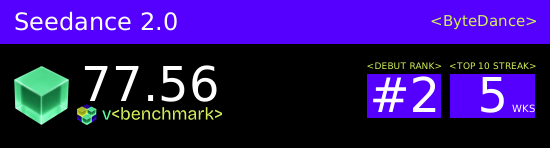
Seedance 2.0 earns a score of 73, placing it first in our rankings with an eleven-point lead over its closest competitor. This also represents an improvement of approximately 38% over the previous generation, which scored 53 points and ranked tenth.

The model’s greatest strength is its cinematic sensibility. Despite its limited understanding of the physical world, it can render complex action and physical interactions convincingly enough to produce usable first-pass results with relatively little iteration.

Its primary weakness is scene logic, object consistency, and general world understanding. Some failures can be mitigated through better prompting, and experienced users will learn to structure their instructions around the model’s limitations. Nevertheless, small logical errors can make Seedance expensive to use when repeated generations are required to correct otherwise minor problems.

Text-to-video and image-to-video perform at a broadly comparable level, allowing users to begin with either a written prompt or a reference image without sacrificing overall quality. This flexibility is valuable for both production workflows and early-stage ideation. As with most video models, however, providing a starting frame produces more predictable and controllable results.

Given its premium pricing, Seedance is best suited to professional users and creators who can justify higher credit or token costs in exchange for footage that more closely resembles live action. For users who would otherwise spend heavily regenerating weaker models, its higher upfront cost may ultimately prove more economical.

Creators who are less concerned with visual fidelity may find older or open-source models more appropriate. The same applies to users with strict copyright, provenance, or compliance requirements.

Conclusion

With a score of 73, Seedance 2.0 is the most capable video model we have tested to date. It earns that position through its versatility, craftsmanship, cinematic quality, and a level of anatomical and physical accuracy unmatched by its competitors.

Its most significant drawbacks are its inconsistent understanding of scene logic and the serious copyright and compliance concerns raised by its apparent reproduction of recognizable protected material. Even with those limitations, Seedance 2.0 establishes a new benchmark for generative video quality.

Category Scores

Physics
0.0
Animation
0.0
2D Animation
0.0
3D Animation
0.0
Anime Animation
0
Prompt Adherence
0.0
Logic Consistency
0
Scene Consistency
0.0
Human
0.0
Hands
0.0
Cinematography
0.0
Text Fidelity
0

Reliability

Percent of evaluated clips passing each check

MetricClean clips
Banding-Clean0%
Clean Framing0%
Compression-Clean0%
Exposure-Safe0%
Frame-Rate Authentic0%
Freeze-Free0%
No Black Frames0%
No Flash/Strobe0%
Progressive Scan0%
Technical Cleanliness0%

Value

Real model price per minute, score, and dollars per score point

Score (%)00000
Seedance 2.0
Kling 2.6
Veo 3
$0.00$0.00$0.00$0.00$0.00
Cost per minute ($)

Characteristics

Descriptive signals, not better-or-worse scores

MetricResultDescription
Colour-Temp Stability0.53 (low = steady)How little warmth/coolness drifts across a shot.
Colour usagesaturation 11, hue spread 2Saturation / palette variety (not gamut coverage).
Fine-Detail Level0.018 [as-delivered]Amount of fine texture (resolution-driven).
Motion / Dynamic Degree2.6How much the clip actually animates.
Native Frame Rate23.8 fps of 24 claimedDistinct frames vs claimed rate.
Tonal Rangeblacks->7, whites->236 (of 0-255)How deep the blacks / bright the whites reach.

Quality

Motion-compensated stability scores

Edge Stability0.0
Geometry Stability0.0
Motion Integrity (avg)0.0
Temporal Stability0.0
Overall score
0.0

ByteDance's Seedance 2.0 is a unified text-to-video and image-to-video model released in early 2026, built around precise motion rendering, consistent characters, and synchronized audio. It's debut marked controversy and backlash in Hollywood and marked an inflection point for AI video.